

This note was written on March 20, 2024.
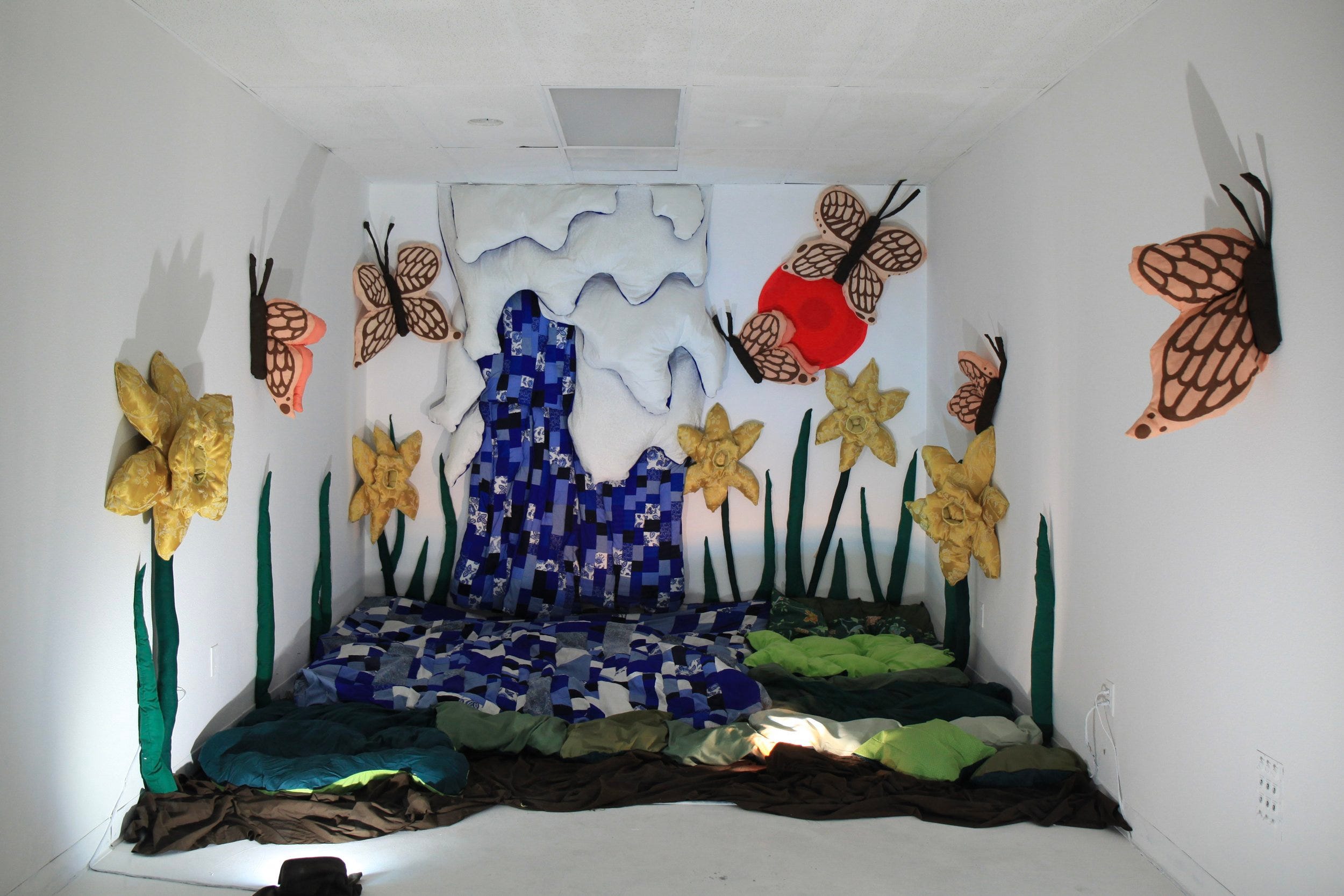
Esther Marie Hall, another world is possible (installation view), 2022
Institutional Critique is an art practice and critical theory that focuses on examining and questioning the structures, practices, and ideologies of cultural institutions, such as museums, galleries, universities, and other art-related organizations. The primary goal of institutional critique is to interrogate the power dynamics, biases, hierarchies, and exclusions embedded within institutional frameworks. Artists and theorists engaged in institutional critique often challenge the ways in which institutions shape the production, presentation, interpretation, and distribution of art and culture.
...and as you probably know, I’ve actively engaged in critiquing numerous Sacramento art institutions, leveraging my dual perspectives both as an insider, having served as a staff member within these institutions, and as a community member advocating for change from outside their walls. Through rigorous examination and constructive critique, I’ve sought to hold these institutions accountable to their missions of fostering creativity, inclusivity, and cultural enrichment for all Sacramentans.
Artists Daniel Alejandro Trejo and Esther Marie Hall recently engaged in institutional critique at Verge Center for Contemporary Art, where they both participated in the studio program. You will find some of their critique in these art notes. Trejo and Hall (Both Brown & Queer) were subsequently evicted from their studios for daring to question, challenge, or interrogate the predominately white-led and centered institution and its executive director, Liv Moe.
I firmly believe in the power of critique. I advocate for a culture where artists and art institutions, particularly within our city, are not only open to receiving critique but actively seek it out as a means of growth and improvement. It’s essential that we foster an environment where listening, learning, and taking meaningful action in response to critique are valued principles. By embracing constructive feedback, we can work together to create a more dynamic, inclusive, and responsive arts community that truly reflects and serves the diverse needs and perspectives of our city.

Daniel Alejandro Trejo, I’m Never Going to Look at the Sunset the Same Way Again, 2018, 22” x 23”x 2”, Underglazed Ceramic
“In our mandatory Studio Artist Meeting, we asked for intentional Diversity, Equity and Inclusion – in which I applauded Verge for their work in gender and generational diversity, but they needed significant work in racial diversity and called out their performative gestures and instances of tokenization. The work on DEI was not done with intention or meaning, but obviously done for the sake of optics and hopes for receiving more grant funding. We were met with defensiveness from the director, artists expectedly coddled and enabled the behavior: then you be the leader. It’s alarming when BIPOC bodies are burdened to resolve the issues created by institutional racism. We did not design this program. As a Brown Queer, I didn’t feel safe speaking out to a group of symbolic authority figures that create obstacles instead of dismantling them.” -Daniel Alejandro Trejo Instagram | Website
Trejo was a resident at Verge Center for the Arts where he maintained his studio practice (evicted on Friday 3/15/24)
Born in Stockton, CA, Daniel Alejandro Trejo is an emerging Latinx artist working in ceramic sculpture. He received his BA in Art Studio and Art History from University of California, Davis. Subsequent to completing his undergraduate studies, he obtained studio residency at Verge Center for the Arts in Sacramento. He concurrently taught ceramic classes as an educational associate at Verge. Trejo also participated in group shows at venues in Los Angeles, Austin, Chicago and has held solo exhibitions in Sacramento at Panama Art Factory’s gallery and at Alpha Fired Arts gallery. He has also co-organized and curated Sacramento Zine Fest under Unibrow Collective, a Sacramento based collaborative. Trejo has also been the recipient of The Howard R. Kottler Testamentary Trust Scholarship, and has participated in an intensive two-week residency at Watershed Center for the Ceramic Arts in Newcastle, ME.
“As a studio artist at Verge, it was extremely discouraging walking through the doors into the studio project every day and the first 5 faces you see are white, amongst both staff and residents. As a POC, you are immediately sent into fight or flight and become hyper aware that this space is potentially not for you and you may actually not be safe. My work has always been about the oppressive structures we live within, but now, I was working directly under one with an authoritarian-esque “leader” who does not allow any discourse, feedback, or questioning accompanied by a predominantly white studio space.
In my time there, I really didn’t see many of these artists show up because they had second studio spaces and I realized that these people had never really struggled and experienced the BIPOC mentality of “I paid for it, I NEED to use it so it doesn’t go to waste” because a majority of us do not have expendable income to do so. My studio neighbor’s space became riddled with cobwebs after not seeing her for 8 months and really just became a storage space of sorts. This is unfortunately the majority of spaces in the Verge Art Studio Project. Verge touts their subsidized studio spaces and in their guiding principles writes: “Verge is committed to becoming a more open and welcoming organization. Historic and systemic discrimination have created barriers to inclusion, participation, and opportunity that have excluded the embracing of different ethnicities, skin colors, gender identities and body types, religious beliefs, physical or cognitive challenges, or socio-economic standing.” But this is unfortunately untrue. Upon my leaving, the studio project had a total of 7 BIPOC artists out of 36 and 1 BIPOC out of 7 office staff members. Where is the inclusion? Where is the embracing of different ethnicities, skin colors, and gender identities? Because here we are in 2024 asking for inclusion, gender neutral bathroom signs, and begging for clean water in a contemporary art space, but instead we are met with micro aggressions and evictions.” - Esther Marie Hall Instagram Website
Hall was a resident at Verge Center for the Arts where she maintained her studio practice (evicted on Friday 3/15/24)
Esther Marie Hall is a multidisciplinary artist with a primary focus on fiber and textile work based in Sacramento, CA. She uses her work to illustrate her cultural identity through the use of traditional Filipino and American crafting techniques such as weaving, crocheting, embroidery, and quilting. Esther utilizes these mediums with the intention of expanding this material’s language and reconfiguring the meaning of what a quilt can and cannot be, by stretching and skewing forms, using an array of material not typically found in traditional quilting, and thinking about them compositionally as paintings. Quilting has a long history of resistance and documenting the current state of affairs, so the use of this medium felt streamlined as her work has long had existentialist, anti-authoritarian, and climate disruption undertones. Hall predominantly collects and hoards fabric related ephemera and uses donated and secondhand materials as a representation of quantum entanglement with the idea of carrying on any energy the previous owner had intended for the material. Esther was born and raised in Northern California and has resided in Sacramento since 2011. She attended the Fashion Institute of Design & Merchandising in San Francisco where her practice in textiles began. Hall has worked with organizations such as the Latino Center of Art and Culture, Planned Parenthood, and Facebook, and has shown work throughout California, Florida, Kentucky, and Washington.
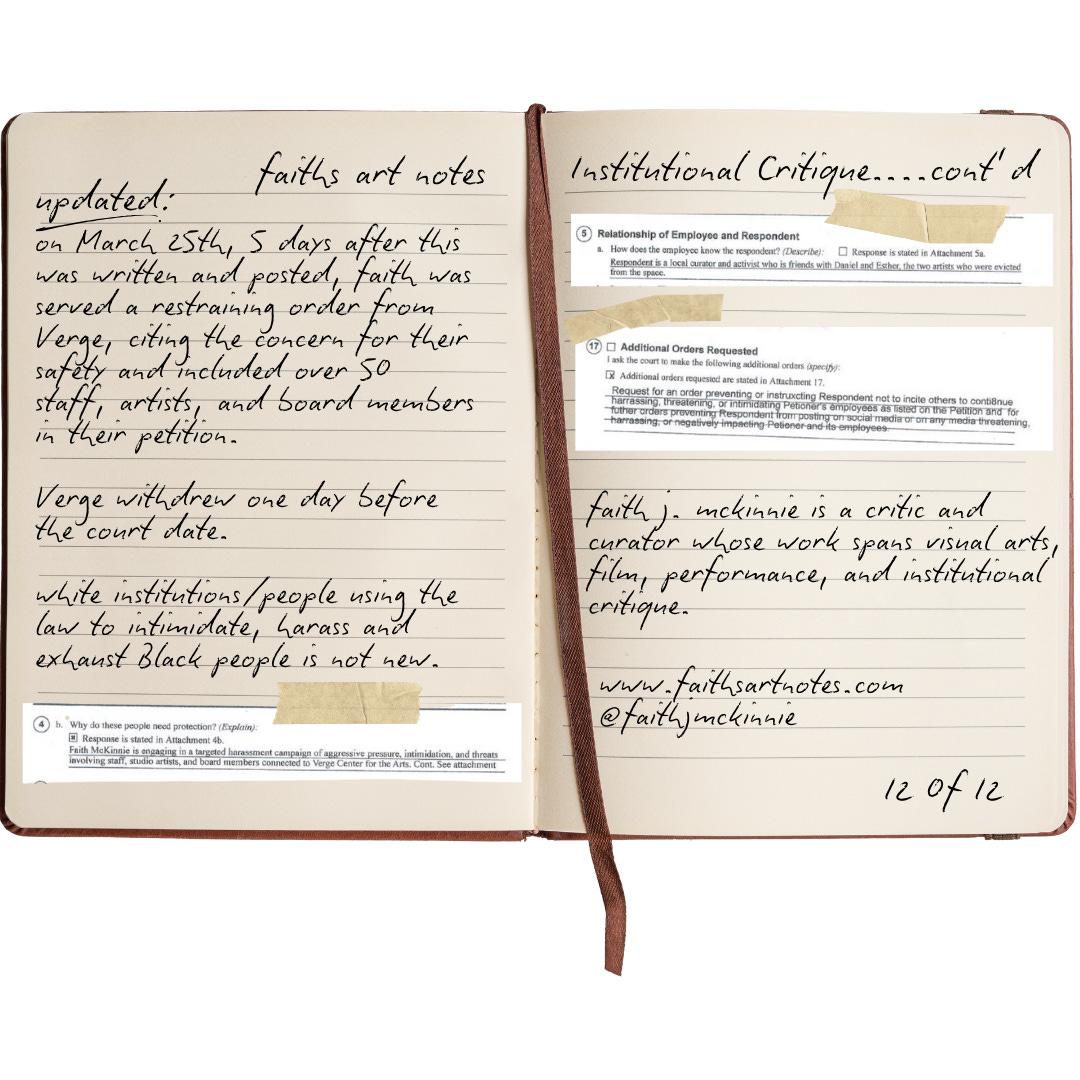
On April 2, 2024 I recorded Advocate + Critic + Curator Talk on YouTube discussing Verge’s response to this institutional critique.